

Insurance is one of the industries where customer experience problems are well documented and largely unresolved. McKinsey found that 6 in 10 customers switch channels before purchase, with transitions between channels often abrupt or nonexistent, leaving customers repeating themselves at every step. At the same time, siloed legacy systems make it difficult for companies to maintain a unified view of the customer experience. Customers increasingly expect seamless, omnichannel interactions, yet many journeys remain fragmented. Accenture points to these siloed legacy systems as the structural root cause: when policy, claims, and billing platforms live in isolation, a unified view of the customer is nearly impossible.
Operational processes add another layer of friction. Core workflows like claims handling still rely heavily on manual steps, from data entry to document verification, slowing down resolution times and limiting scalability. This fragmentation is especially visible in traditional touchpoints like IVR systems, where customers often navigate complex menus only to restart their journey when handed off to another channel.
We set out to explore what a modern alternative could look like: an AI-driven system capable of owning the full customer interaction, from the first question to resolution, across any channel. Rather than treating chat, claims, and document processing as separate systems, the goal was to unify them under a single intelligent agent that can reason, act, and maintain context throughout the entire journey.
To be clear upfront: this is not a product AVIO is selling. It is a reference implementation we built to explore and validate the architecture of a production-grade AI agent. Insurance is the domain we chose; the patterns and lessons apply broadly.
The System at a Glance
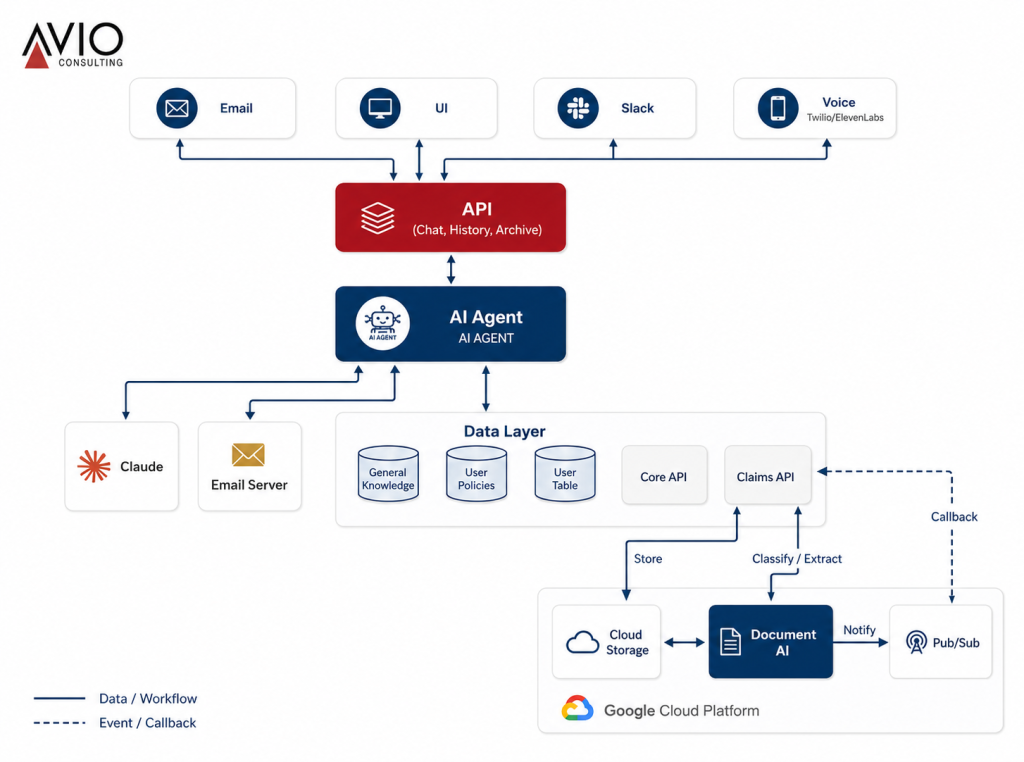
The solution is built around six components that work together:
- Channels: Web, Email, Slack, and Voice, each implemented as a thin adapter that connects to the same agent
- Web: a React/TypeScript customer-facing portal for chat, claims, policy management, and document uploads
- AI Agent: A Python/FastAPI service built on LangGraph, the central orchestrator for all customer interactions
- Core API: A Python/FastAPI service responsible for insurance business logic, including policies, quotes, premiums, and gap analysis.
- Claims API: A Java/Spring Boot service that manages document ingestion, classification, and extraction using Google Cloud Platform.
- PostgreSQL + pgvector: A shared PostgreSQL instance (with pgvector) storing both operational data and vector embeddings for semantic search. Each service maintains clear ownership over its portion of the schema.
The AI Agent: The Brain of the System
Every customer interaction flows through the AI agent, regardless of the channel it originates from. The agent is built using LangGraph, a framework for designing stateful, multi-step conversational workflows.
Each conversation is checkpointed to PostgreSQL, allowing the agent to maintain context across turns, sessions, and even channels. A customer can start a conversation on the web, follow up via email, and continue over voice without losing continuity.
The agent acts as a decision layer. It interprets user intent, determines the next action, orchestrates API calls, and assembles responses. To balance performance and quality, the agent uses two LLMs with distinct roles:
- Claude Haiku: Handles fast intent classification to keep latency low
- Claude Sonnet: Generates responses when deeper reasoning and higher quality are required, including handling complex interactions and gracefully deflecting off-topic or unsupported requests
The agent does not store or manage business data directly; it calls out to Core API for policies, quotes, and gap analysis, and to Claims API for claim status and document data.
For general inquiries, the agent retrieves context from a pgvector-powered knowledge base built from policy documents, ensuring responses are grounded in real data rather than model assumptions.
How Channels Connect to the Agent
The system is designed to be channel-agnostic. The agent exposes a single interface and is fully decoupled from the originating channel.
Each channel is implemented as a thin adapter responsible only for input/output handling:
- Web: Real-time (streaming) chat via WebSocket
- Email: Gmail integration using IMAP/SMTP with thread-aware responses
- Slack: Socket Mode integration supporting direct messages and threaded conversations
- Voice: Telephony via Twilio, with speech-to-text and text-to-speech powered by ElevenLabs
This design allows new channels to be added with minimal effort. As long as a new adapter can translate its input into the agent’s text-based interface and map responses back to the channel-specific format, the rest of the system remains unchanged.
Document Intelligence: From Upload to Structured Data
Document processing is a key part of the claims workflow. When a customer uploads a document, the system transforms it into structured, actionable data through an automated pipeline:
- The document is uploaded and stored in Google Cloud Storage
- A Document AI Custom Classifier determines the document type
- The document is routed to a specialized extractor (e.g., Driver’s License, Repair Quote, Insurance Card)
- The document is processed either synchronously (for immediate responses) or asynchronously via Cloud Pub/Sub, which delivers a completion callback once extraction is finished
- Extracted fields are stored in PostgreSQL and made available to both the web application and the agent through the Claims API
This approach removes manual document review from the process and integrates document understanding directly into the customer journey.
Seeing It in Action: A Complete User Journey
To understand how the system works end-to-end, consider a typical scenario.
A customer opens the web chat to report an auto accident. No human agent is involved at any point.
They describe the incident. The AI agent classifies the intent as a claim submission and guides the user through providing the required information: date, location, description, and involved parties. Once all necessary details are collected, the agent generates a structured claim summary and asks for confirmation.
After the customer confirms, the agent submits the claim through the Core API, creating a new claim record. It then prompts the user to upload supporting documents.
The customer uploads a driver’s license and a repair estimate directly through the web interface. The Claims API processes each document, extracts structured data using Google Document AI, and stores the results in PostgreSQL.
The agent acknowledges the submission, provides a claim number, and confirms that all required documentation is on file.
If the customer follows up later (whether through chat, email, or voice), the agent resumes the conversation with full context, without requiring the customer to repeat any information.
Why This Architecture Matters
The value of this system is not in any single component, but in how they work together:
- The AI agent centralizes decision-making and orchestration
- Channels become interchangeable, not siloed entry points
- Document processing becomes part of the conversation, not a separate workflow
- Context persists across the entire customer journey
This creates a fundamentally different experience in which the system adapts to the customer rather than forcing the customer to adapt to the system.
How AVIO Consulting Can Help
What we built here is a reference implementation, not a finished product or one-size-fits-all solution. The real value lies in the architecture and the patterns it demonstrates.
The same principles (stateful AI agents, multi-channel integration, and automated document intelligence) apply across industries and use cases.
AVIO Consulting specializes in designing and building integration-driven systems, from initial architecture through production deployment. We combine strong experience in AI and LLM-enabled solutions with deep expertise in integrations, business processes, intelligent document processing, and full-stack delivery across cloud, backend, and front-end applications.
If you’re exploring how AI, intelligent document processing, and integration-driven solutions could apply to your organization, we’d be happy to share what we’ve learned building this system. Reach out to AVIO Consulting to start the conversation.